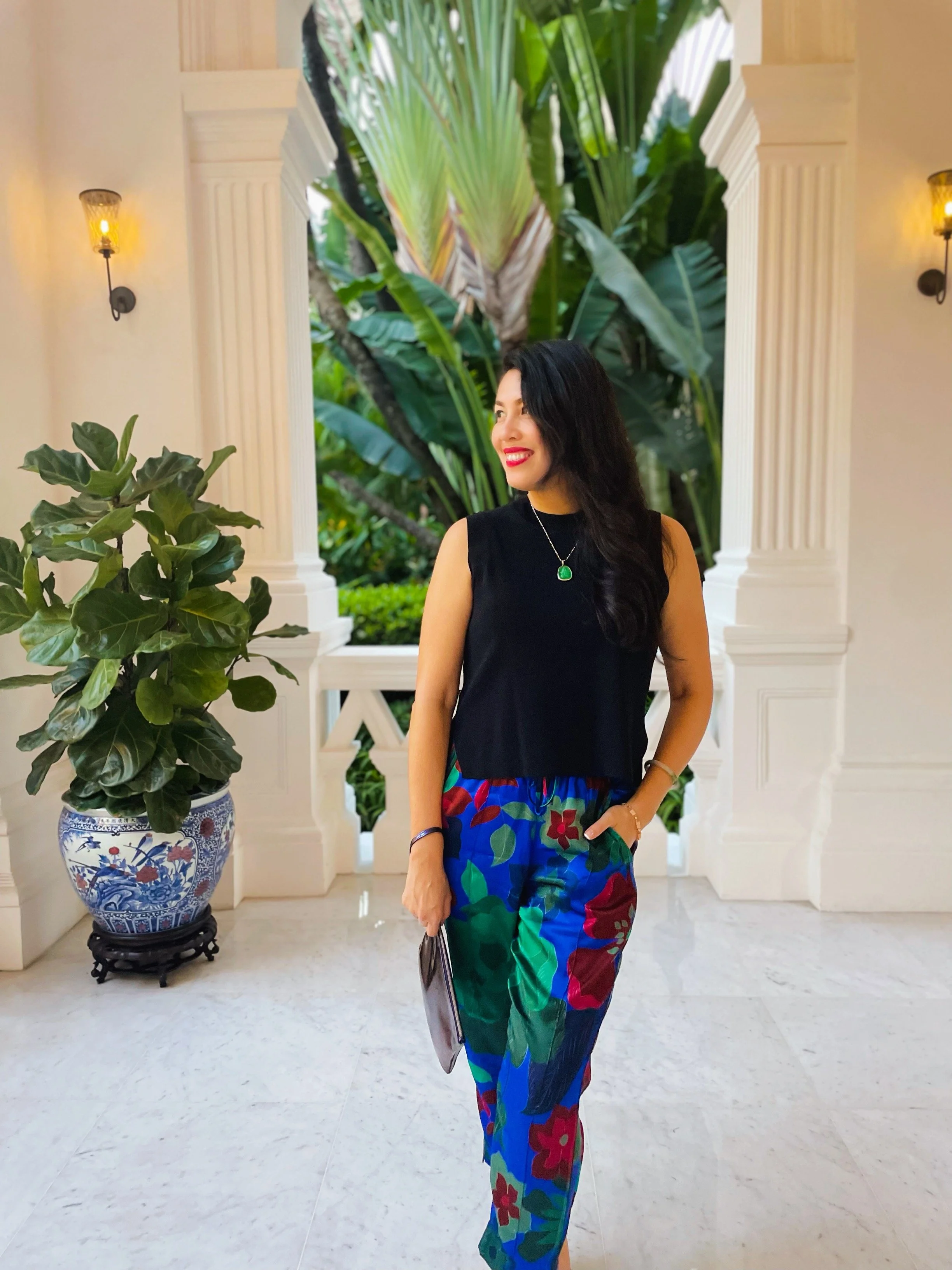
My favorite piece of jewelry is a jade necklace given to me by my grandfather.
Before he passed, he gave me and my siblings three different necklaces. My grandfather wasn’t a man of many words, but I remember him being intentional about telling me that these weren’t just pieces of jewelry, but amulets. Even at a young age, I understood that they were meant to protect us long after he was gone.
Decades later, I still wear this necklace, most especially when I’m traveling long distances. Knowing I am wearing my grandfather’s protective energy, I move around the world with a feeling of security.
Earlier this year, more of my loved ones also became ancestors.
Since they’ve crossed over to the afterlife, I’ve begun to have a more profound curiosity and connection to ancestral wisdom that has inspired me to cultivate a daily practice of honoring family members who have passed. But if you’ve grown up in the West like me, you might have been cut off from this practice, possibly even labeling it as ‘woo-woo’ or just plain weird.
But in this current timeline where the world feels increasingly volatile, I feel called to encourage us to reclaim ancestral wisdom. To intentionally invite those who came before us to give us guidance, and to tap into this well of knowledge that extends beyond our lifetime.
The thing is, ancestral worship is common around the world. Across Asia, Africa, Latin America, Polynesia, and beyond, honoring ancestors is a tradition that has continued for centuries, and is still embedded into daily, present-day life.
But it’s interesting to me that in the West, ancestral wisdom has largely been discredited as a legitimate form of intelligence. I’ll go even as far as to say that it's been ‘demonized’: spirits have become ghouls & ghosts haunting us, rather than blessing and guiding us.
In pre-colonial Philippines, indigenous folk religions were animist in nature, meaning that it was believed that objects, places, creatures and living beings like plants, bodies of water, etc. all had a spiritual essence. As such, they behaved in a way that respected the life and soul in all things, a culture that fed the spirit of kapwa, a sense of interconnectedness that fostered the belief that our well-being was intertwined with the well-being of others. With kapwa being core to the Filipino identity, solidarity was widely felt across the Philippine islands in pre-colonial times.
But when the Spanish colonized the Philippines and brought Catholicism to the archipelago, the animist belief system was discredited and unaccepted as a form of worship, reserving the concept of worship solely to the Catholic God. With the spread of Catholicism, ancestral worship and wisdom died down, and with it, the ability for Filipinos to be rooted in kapwa. The solidarity that once held the country and its people together, began to fade.
Perhaps this was intentional all along.
In his book, Living Buddha, Living Christ, Thich Nhat Hanh described the religious conversion that the Catholic French enacted with Vietnamese Buddhists as “spiritual warfare”. He described it as one of the most violent forms of colonization: to cut an entire people’s spiritual roots off from their ancestral lineage, from their source of inner power, was not only a takeover of land, but a brutal conquest of the soul, heart, and mind*.
So, what if our resistance looked like hundreds and thousands of us on the journey to taking back our divine inheritance by inviting ancestral wisdom in our daily lives?
What would it look like if we all tapped in and intentionally asked our ancestors to guide us through this new world we’re actively creating? What if there’s something sacred waiting to be channeled through us amidst the chaos of an old world crumbling?
What I know for certain is that my loved ones still communicate with me from the other side. Skeptics might call this peak ‘woo’, but the timing and synchronicity of their messages and the prayers they’ve answered with specificity leave me enough evidence to believe that our relationship continues across two different dimensions, and that I have access to guidance that goes beyond the logic of materiality.
What I also know for certain is that we MUST create systems of collective care. To embody the universal spirit of kapwa. And just maybe, returning inward to access our ancestors’ guidance could help us reconnect not only to ourselves, but to each other.
My jade necklace may look common at first glance. But knowing I’m wearing my grandfather’s prayers grounds me in a presence and power that transcends this lifetime, a presence that inspires me to see the good in others.
This a-wear-ness is available to us all.
*My intention is not to discredit or pose any disrespect to the Catholic faith. I respect everyone’s chosen religion/spirituality. However, my belief is that we cannot ignore the very real impact of religion as a vehicle for colonialism. We must interrogate history so we can build a more empowered future.